
Most therapy keywords are vague. Someone typing “therapist near me” could want anything: couples work, a teen counselor, grief support, or just someone to talk to. EMDR is different. When someone searches “emdr therapist near me”, they have already done their research, already decided on the method, and are now looking for exactly one thing: a person trained in it who can see them. That is why EMDR therapist SEO is one of the best niche plays in private-practice marketing, and why it deserves its own strategy instead of a bullet point on your services page.
I have spent 13 years doing SEO for small businesses, and the pattern holds across every industry: the more specific the search, the closer the searcher is to buying. In therapy, “emdr therapist [city]” is about as specific as it gets. This post covers the whole play: what EMDR search demand actually looks like, how to structure the pages that capture it, how remote EMDR changes the map, how to use your certification without sounding like a diploma wall, and what the results look like at a real practice we work with.
Why EMDR searches convert better than almost any therapy keyword
Think about the journey behind an EMDR search. Nobody stumbles into that acronym. Before someone types “emdr therapy near me”, they have usually:
- Heard about EMDR from a friend, a podcast, a book, or a previous therapist
- Read enough to believe it might help their trauma, anxiety, or PTSD
- Decided they want this method specifically, not therapy in general
That is a pre-sold visitor. Your page does not have to convince them therapy works or that EMDR works. It only has to convince them that you are the right EMDR therapist and make it easy to reach out. Compare that to a generic “therapist near me” searcher, who might browse eight profiles and ghost all of them.
The demand is real and it is broad. EMDR keyword searches come in more flavors than most therapists expect:
- Local commercial: “emdr therapist [city]”, “emdr therapy near me”, “emdr [city] [state]”
- Virtual: “virtual emdr therapy”, “online emdr therapist [state]”, “remote emdr”
- Condition pairings: “emdr for ptsd”, “emdr for anxiety”, “emdr for childhood trauma”
- Research and objection queries: “does emdr work”, “what is emdr like”, “emdr side effects”, “emdr vs talk therapy”
Each group maps to a different page or post, and together they form a small topical cluster that tells Google your site is genuinely about EMDR, not a directory that mentions it. You can pull the actual search numbers for your own city with our free therapy keyword tool; in most mid-sized markets the local EMDR terms have real volume and embarrassingly weak competition. A handful of Psychology Today profiles and two-paragraph service blurbs is often all you are up against.
And the economics are strong. A new therapy client is worth roughly $2,000+ in lifetime value (around $150 a session over 15+ sessions). EMDR clients, who often commit to a full course of treatment, sit comfortably in that range. You do not need hundreds of visitors. You need the 30 people a month in your city searching for exactly what you do to find your page instead of a directory.

The EMDR specialty page: structure that ranks
Here is the mistake I see on almost every therapist website that offers EMDR: it lives as one line on a services list. “I offer CBT, DBT, and EMDR.” Google does not rank businesses, it ranks pages, and a one-line mention cannot outrank a competitor’s 1,200-word dedicated page. If you take one thing from this article: EMDR needs its own page.
A page that ranks for “emdr therapist [city]” follows a consistent anatomy:
1. A title and H1 that match the search. “EMDR Therapy in Bismarck, ND” beats “Healing Through Reprocessing”. Poetic titles cost you rankings; searchers and Google both want to see the words they typed.
2. A plain-English explanation of EMDR. Two or three short paragraphs: what EMDR is, what a session actually involves (eye movements or bilateral stimulation, the eight phases in human terms), and who it tends to help. Skip the academic citations. Your visitor half-knows this already; you are confirming you know it deeply.
3. Who you work with. Name the problems: PTSD, single-incident trauma, childhood trauma, anxiety, phobias. Specificity here does double duty, ranking for the “emdr for [condition]” pairings and helping the visitor self-identify.
4. Your training, stated simply. More on this below, but this is where “trained in EMDR through an EMDRIA-approved program” or “EMDRIA Certified Therapist” lives, one sentence, near the top.
5. What working with you looks like. Session length, typical course of treatment, in-person or virtual, insurance or private pay. Logistics kill more inquiries than anything else; answer them on the page.
6. An FAQ section. Five to eight real questions (“How many EMDR sessions will I need?”, “Is EMDR done online?”) with two-to-four sentence answers. This captures long-tail searches and feeds FAQ schema.
7. One clear call to action. A consult button or contact form. One action, repeated, not five options.
Aim for 1,000 to 1,500 words. That is not padding; it is what fully answering the search takes. Thin pages do not rank for health topics, where Google’s quality guidance explicitly rewards demonstrated expertise and depth. This structure is the same playbook we run on every specialty page we build, and it is the core of our therapist SEO service.
One page or several?
If EMDR is a side offering, one strong page is enough. If it is your core specialty, build the cluster:
| Page | Target searches | Priority |
|---|---|---|
| EMDR Therapy in [City] | emdr therapist [city], emdr near me | Build first |
| Virtual EMDR in [State] | online emdr [state], virtual emdr therapy | Build second if you work remotely |
| EMDR for PTSD / trauma | emdr for ptsd, emdr for childhood trauma | Third |
| Blog: What an EMDR session is like | what is emdr like, does emdr work | Ongoing |
Each page targets its own keyword group. Together they make you the obvious local authority on the topic, which lifts every page in the cluster.
Remote EMDR: one license, a whole state of searches
Here is the part of EMDR therapist SEO that almost nobody is doing, and it is the biggest opportunity on this page.
EMDR adapted to telehealth better than most expected. Virtual bilateral stimulation tools and screen-based protocols made remote EMDR a standard offering, and search behavior followed: people now search “virtual emdr therapy” and “online emdr therapist [state]” in meaningful numbers. Those searchers do not care what city you are in. They care that you are licensed in their state and trained in EMDR.
That changes your addressable market completely. A traditional local page competes for one city. A virtual EMDR page competes for an entire state:
- You are licensed in one state: build one page, “Virtual EMDR Therapy in [State]”, targeting the state-level terms. You are now visible to every searcher in the state, including cities with zero EMDR providers.
- You hold licenses in multiple states (or PSYPACT authority, for psychologists): build one page per state. Each is its own ranking opportunity with its own keyword group, and state-level virtual terms are usually far less competitive than big-city local terms.
The structural rules are the same as the local page, with two changes: lead with licensure (“licensed in North Dakota and Minnesota”) because it is the searcher’s first eligibility question, and address the “does EMDR work online?” objection head-on, since it is the number one hesitation for virtual EMDR searchers.
For group practices this compounds. Three clinicians licensed across five states is fifteen state-level ranking opportunities that most competitors have never thought to build pages for.
Certification credibility: use it, in plain English
EMDR has something most therapy modalities lack: a recognizable credentialing body. EMDRIA (the EMDR International Association) defines training standards, and searchers know it. People comparing EMDR therapists genuinely look for words like “EMDRIA trained” and “certified” on the page.
So say it plainly, once, near the top of your EMDR page:
- “Trained in EMDR through an EMDRIA-approved program”
- “EMDRIA Certified Therapist” (if you hold the certification)
- “EMDRIA Approved Consultant” (if you are one, this is a genuine differentiator)
Be exact about which tier you hold. Overstating a credential is an ethics problem and a trust problem. Understating it is just bad marketing. One sentence of accurate credential language does more for conversion than three paragraphs about your therapeutic philosophy.
Two side benefits. First, EMDRIA’s own therapist directory is a legitimate, relevant place for your practice to be listed, which is exactly the kind of citation local SEO likes. Second, clearly stated training feeds the expertise signals Google looks for on health content. Your license number, your training lineage, and your years of practice are all things a content mill cannot fake. Put them on the page.
One thing certification does not replace: reviews. Reputation matters in local rankings, but therapists cannot ethically solicit reviews from current clients (APA, ACA, and NASW ethics codes all restrict it, and HIPAA complicates even responding to reviews). The compliant play is building reputation through colleague referrals, professional listings, community presence, and letting unprompted reviews accumulate. We wrote a full guide on handling therapist reviews ethically; the short version is that your certification and your content have to carry more weight precisely because you cannot run the review playbook a plumber can.

What this looks like in practice: Dakota Trauma Therapy
Theory is cheap, so here are real numbers. Our client Dakota Trauma Therapy is a trauma-focused practice in Bismarck, ND that offers EMDR. We rebuilt the site on exactly the structure described above: dedicated specialty pages, an EMDR page with real depth, plain credential language, local signals throughout.
From Search Console, April through July 2026, the practice ranks:
- #1 for “bismarck therapists”
- #2 for “north dakota therapist near me”
- #3 for “trauma therapy bismarck, nd” and “ptsd bismarck nd”
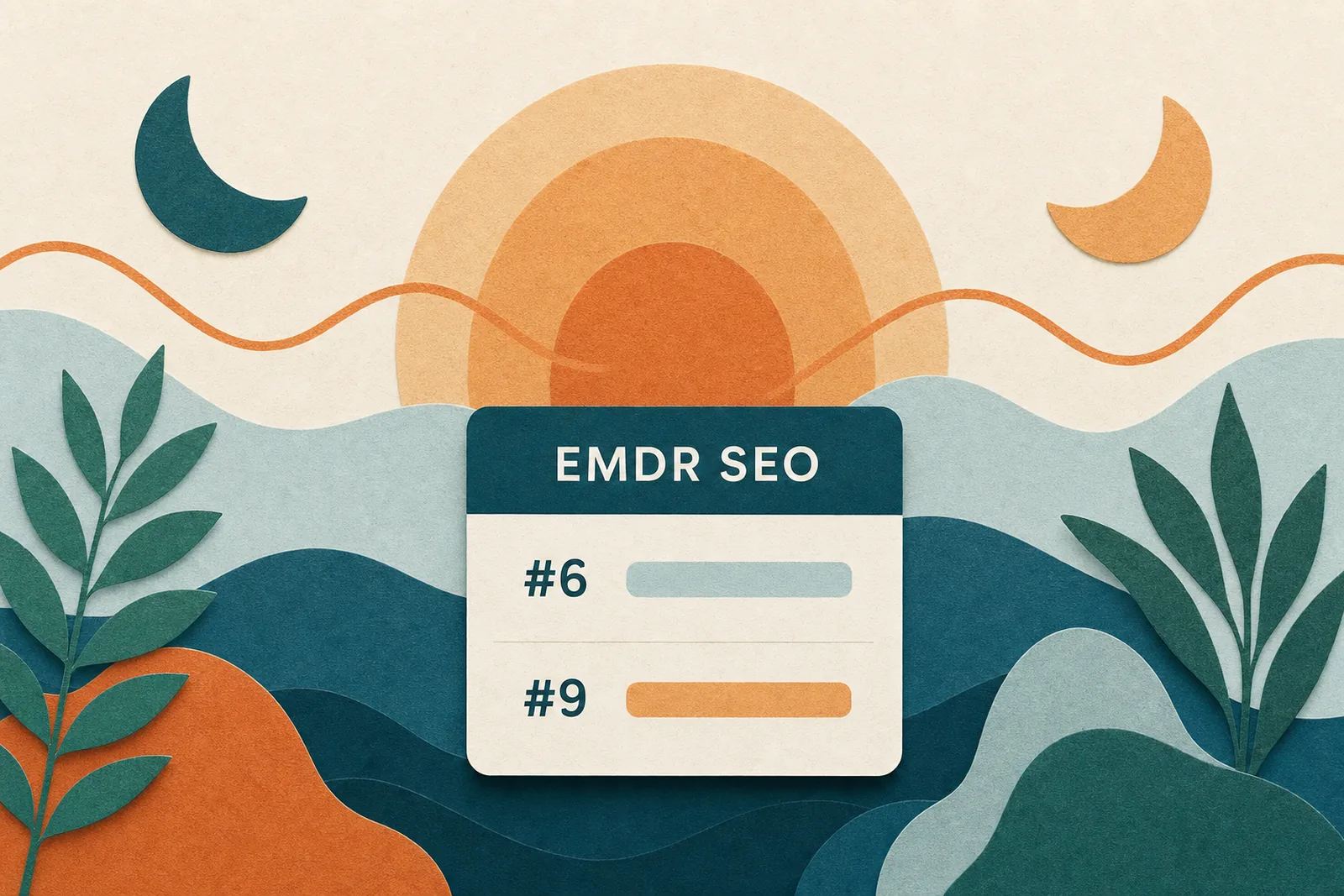
- #6 for “emdr bismarck nd”
- #9 for “emdr therapy bismarck nd”
That is 21 local searches in the top 10 overall, and the EMDR terms are on page one and still climbing (EMDR pages typically take longer to mature than general terms because the searcher pool is smaller and Google needs more signal). Notice the shape of the result: the practice does not just rank for its name or one lucky keyword. It ranks across the whole cluster, generic, trauma, PTSD, and EMDR, because every group has a page built for it. The full breakdown is in the Dakota Trauma Therapy case study.
Also worth noting: Bismarck is not a giant market. That is the point. In small and mid-sized cities, a properly built EMDR page can reach page one in months, not years, because the competition is directories and thin pages. If you are in a market like that, the opportunity is sitting there.
What it costs to have this done for you
You can absolutely build this yourself. The structure above is the actual playbook, not a teaser. It takes a page builder or a decent web designer, 10 to 20 hours of writing, and patience while rankings mature.
If you would rather see clients than write specialty pages, this is what we do. Our plan is one flat $1,500 a month: SEO, the website, content, and local optimization, month to month, no setup fees, no contracts, and we only take one practice per service area (so if we are working with your competitor, we will tell you no). Everything we build, you own. At a $2,000+ lifetime value per client, the plan pays for itself at roughly one new client a month, and a well-ranked EMDR page in a decent market brings more than that.
Find out where you stand
If you offer EMDR and it is buried in a services list, you are invisible for the highest-intent searches in your market, and some directory is collecting those clicks instead. The fix is knowable and finite: one strong local page, a virtual page per licensed state if you work remotely, credentials stated plainly, and a few supporting posts.
Want to know whether your site is set up to rank for EMDR in your city? Run our free Practice Visibility Report. In about a minute it checks for your EMDR and trauma pages, local signals, and speed, and gives you the fix list whether you hire us or build it yourself.
Frequently asked questions
- Is EMDR a good SEO niche for a therapy practice?
- Yes, one of the best. EMDR searchers use the method's name in their search, which signals they have already decided what kind of therapy they want. That makes the traffic smaller than generic 'therapist near me' searches but far higher intent, and in most cities the competition is a handful of practices with thin pages.
- How do I rank for 'EMDR therapist near me'?
- Build a dedicated EMDR page (not just a homepage mention), target 'EMDR therapy in [city]' in the title and headings, cover what EMDR is and what sessions look like in 1,000+ words, list EMDR as a service on your Google Business Profile, and get local citations consistent. Near-me searches are resolved by proximity plus relevance, and the dedicated page supplies the relevance.
- Can I do SEO for virtual or remote EMDR?
- Yes, and it is underused. Build a separate page targeting 'virtual EMDR therapy [state]' for each state you are licensed in. State-level virtual searches are less competitive than city searches, and one page per state can pull clients from cities you have never set foot in.
- Does EMDRIA certification help with SEO?
- Not as a direct ranking factor, but it helps everywhere else. Searchers comparing EMDR therapists actively look for training and certification language, so stating your EMDRIA status plainly improves conversion. It also gives you a legitimate directory listing and strengthens the expertise signals Google's quality guidance rewards for health topics.
Read more

Teletherapy SEO: How to Rank Your Practice in Multiple States
Teletherapy SEO for multi-state practices: PSYPACT and licensure-based targeting, state pages that rank without doorway spam, and what to do about GBP.

AI Search for Therapists: Be the Practice AI Recommends
AI search for therapists explained: how Google AI Overviews, ChatGPT, and Perplexity choose which practices to recommend, and the practical steps to be cited.